


Your schedule says Friday night. Your family needs you Friday night. The problem isn't your English vocabulary—it's finding a polite way to ask without putting pressure on a coworker.
The Big Idea
Name the exact shift, explain only as much as you want to, offer a fair alternative, and confirm any required workplace approval.
10 Practical English Phrases
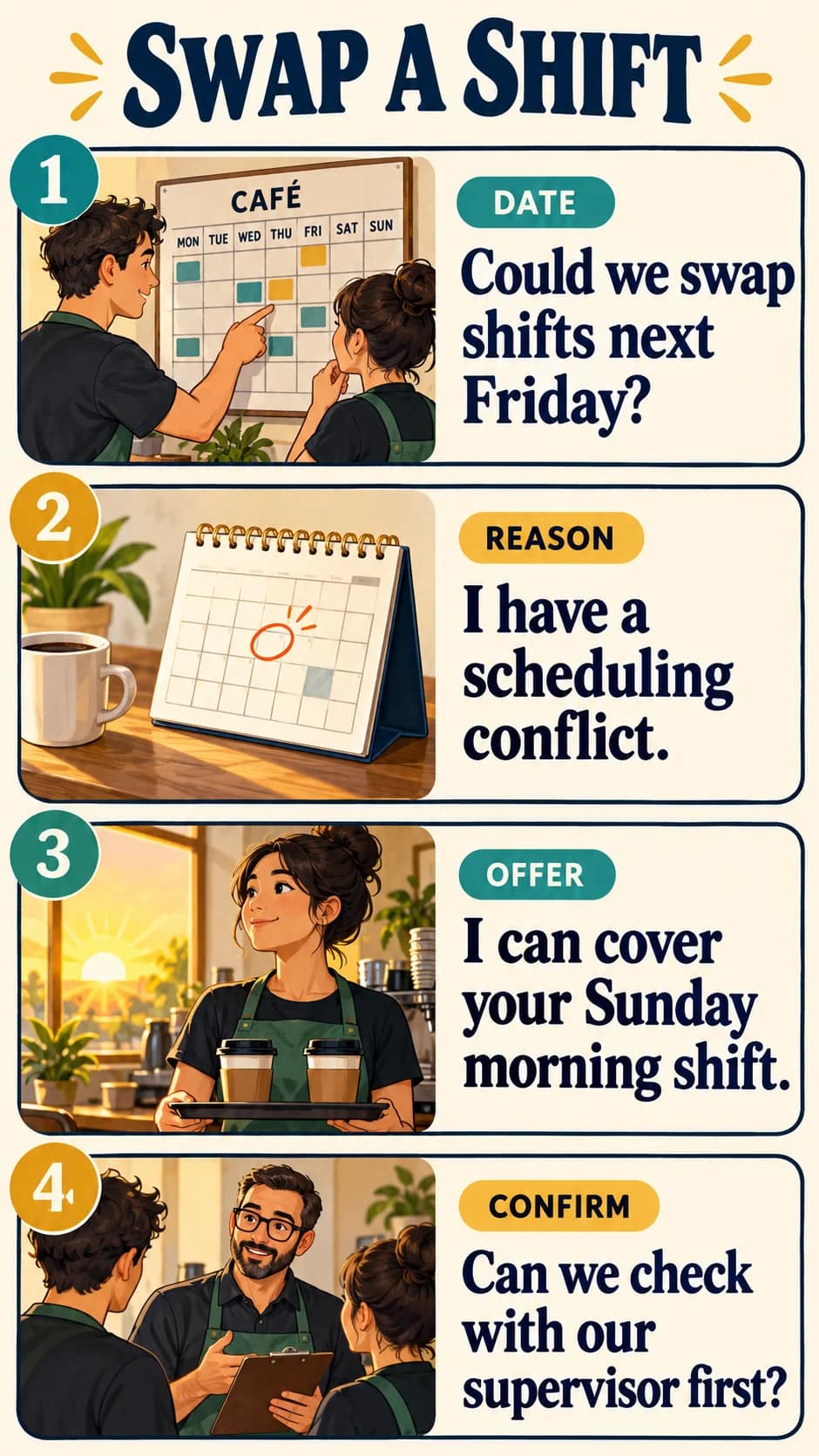
- Could we swap shifts next Friday? — Use 'could' for a friendly, clear request.
- Are you available to cover my evening shift? — Check whether a coworker is free before assuming.
- I have a scheduling conflict. — A professional explanation that doesn't require sharing private details.
- I can cover your Saturday shift in return. — Offer a specific trade that might help the other person.
- I know this is short notice. — Acknowledge a late request without over-apologizing.
- No worries if you can't. — Give the person room to say no.
- Would you prefer to trade shifts or just cover mine? — Check what arrangement is actually being proposed.
- Can I check with our supervisor first? — Many workplaces require approval before any change.
- Could we confirm the change in writing? — A message or updated roster helps avoid confusion.
- Thanks for checking, even if it doesn't work. — End respectfully regardless of the answer.
Real Conversation: Practise This Exchange
ALEX: “Hey, are you free next Friday evening? I have a scheduling conflict.”
MORGAN: “Maybe. Which shift do you mean?”
ALEX: “The four-to-ten shift. Could we swap? I can cover your Sunday morning.”
MORGAN: “That might work. Does the manager need to approve it?”
ALEX: “Yes. I'll ask first and confirm the new schedule in writing.”
MORGAN: “Sounds good. Let me double-check my plans.”
Remember: A tentative yes from a coworker does not replace a workplace scheduling policy or supervisor approval.
Use the Four Finger Rule Before You Speak
You don’t have to memorize a complicated speech. Prepare four useful thoughts:
- WANT TO: I want to attend an important family event.
- HAVE TO: I have to work my assigned shift unless it is changed.
- NEED TO: I need to ask about swapping Friday evening.
- MIGHT: I might cover a coworker's Sunday shift in return.
Problem → Need → Request
Problem: I'm scheduled for Friday evening, but I have a conflict.
Need: I need to find out if a shift change is possible.
Request: “Would you be able to swap with me, subject to our supervisor's approval?”
Before You Go: A Quick Checklist
- Exact date and start/end time
- Your proposed replacement shift or coverage plan
- How much notice the workplace needs
- Who must approve a schedule change
- A way to confirm the approved change
Your 3-Round Speaking Mission
- Round 1: Ask with 'Could we swap shifts…?'
- Round 2: Add a fair trade: 'I can cover your… in return.'
- Round 3: Close with the approval step and written confirmation.
Surprise round: Your coworker is unavailable. Respect the answer, thank them and ask your supervisor what approved alternatives exist.
Natural-English tip: 'Swap shifts' usually means two people exchange assigned shifts. 'Cover a shift' may mean one person works in place of another without a direct trade.
Quick Questions
Do I have to explain why I need the change?
You can keep it brief: 'I have a scheduling conflict.' Follow your workplace's policies.
What if the coworker says no?
Say, 'No worries. Thanks for considering it.' Then explore an approved alternative.
When is a swap final?
Only when the required workplace approval and schedule update are complete.
Keep Practising
Stop memorizing English. Start using it.
Try one conversation today. Repeat it tomorrow with a different detail. Small real missions build confidence.
Learn it. Prepare for it. Go use it.
Four Finger Rule: Start with Free Week 1, or explore the complete 52-week program for US$52 one time.
